Make room for the idea
A raised eyebrow. A pause before the punchline. One bright shape against an empty background. Sometimes the smallest thing does the most work.
For us, minimalism means giving an idea room to breathe. It isn’t a rule that every animation should look stripped back. We love busy worlds and big personalities too. The question is whether each detail helps the story, or gets in its way.
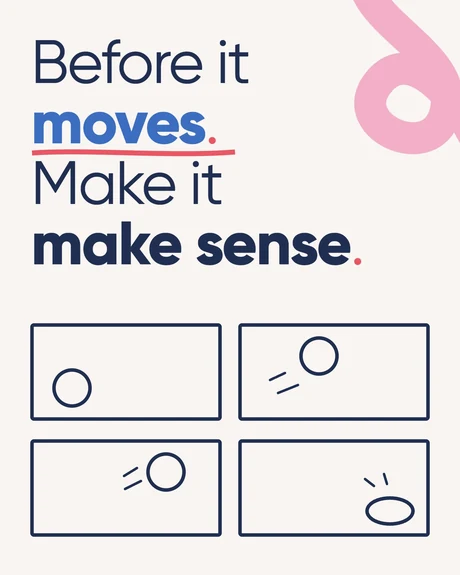
Start with one thing to say
Before choosing a style, we want to know what the audience should take away. If a short film is trying to introduce a brand, explain five services and tell its entire history, something will probably get lost.
Try writing the main idea in one sentence. Then look at the script again. Does each scene build towards it? A lovely line can still be the wrong line for this particular film. Saving it for another day often makes the whole thing stronger.
Give the eye somewhere to go
A smaller palette, a clear shape and some space around the action can help the viewer know where to look. Detail earns its place when it tells us something: a worn sleeve, an awkward posture, a tiny object a character refuses to put down.
Imagine a character waiting for a reply. You could fill the screen with messages, clocks and motion. Or you could hold on a hand hovering over a phone. Both approaches can work, but the quieter one may say everything you need.
Let sound leave some space
An animation doesn’t need music, dialogue and sound effects competing in every moment. A small sound can carry a big feeling when it has room around it.
Try watching a sequence with one layer of audio removed. Does the action become clearer? Does a pause make the next beat more surprising? Silence is a creative choice too.
Keep the process focused
The same thinking helps behind the scenes. A clear brief, a focused review and one agreed set of feedback give everyone more time to solve the interesting problems.
Before making or buying something, it is also worth asking whether we need it or could use something we already have. Keeping things simple can help us avoid unnecessary work and waste.
Try taking one thing away
On your next project, choose one frame, paragraph or scene. Remove something. Then ask whether the meaning is clearer, weaker or unchanged.
Keep what gives the work its character. Lose what makes the audience work harder than they need to. Less can leave room for a much bigger feeling.